Fresh Vegetable Quality Standards for International Exports: A Complete Guide for Global Buyers
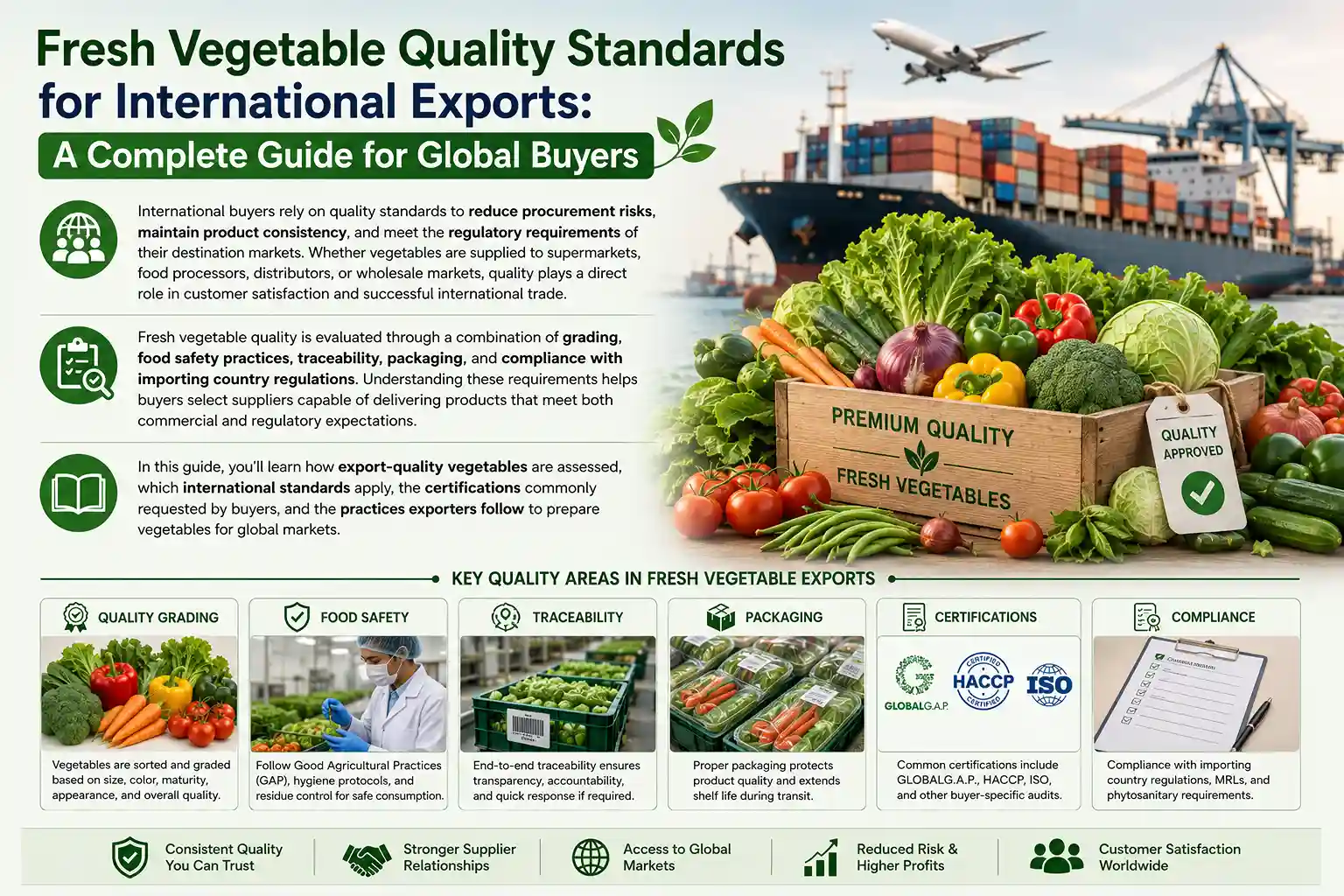
International buyers rely on quality standards to reduce procurement risks, maintain product consistency, and meet the regulatory requirements of their destination markets. Whether vegetables are supplied to supermarkets, food processors, distributors, or wholesale markets, quality plays a direct role in customer satisfaction and successful international trade.
Fresh vegetable quality is evaluated through a combination of grading, food safety practices, traceability, packaging, and compliance with importing country regulations. Understanding these requirements helps buyers select suppliers capable of delivering products that meet both commercial and regulatory expectations.
In this guide, you'll learn how export-quality vegetables are assessed, which international standards apply, the certifications commonly requested by buyers, and the practices exporters follow to prepare vegetables for global markets.
Why Quality Standards Matter in International Fresh Vegetable Trade
India's Position in the Global Fresh Vegetable Export Market
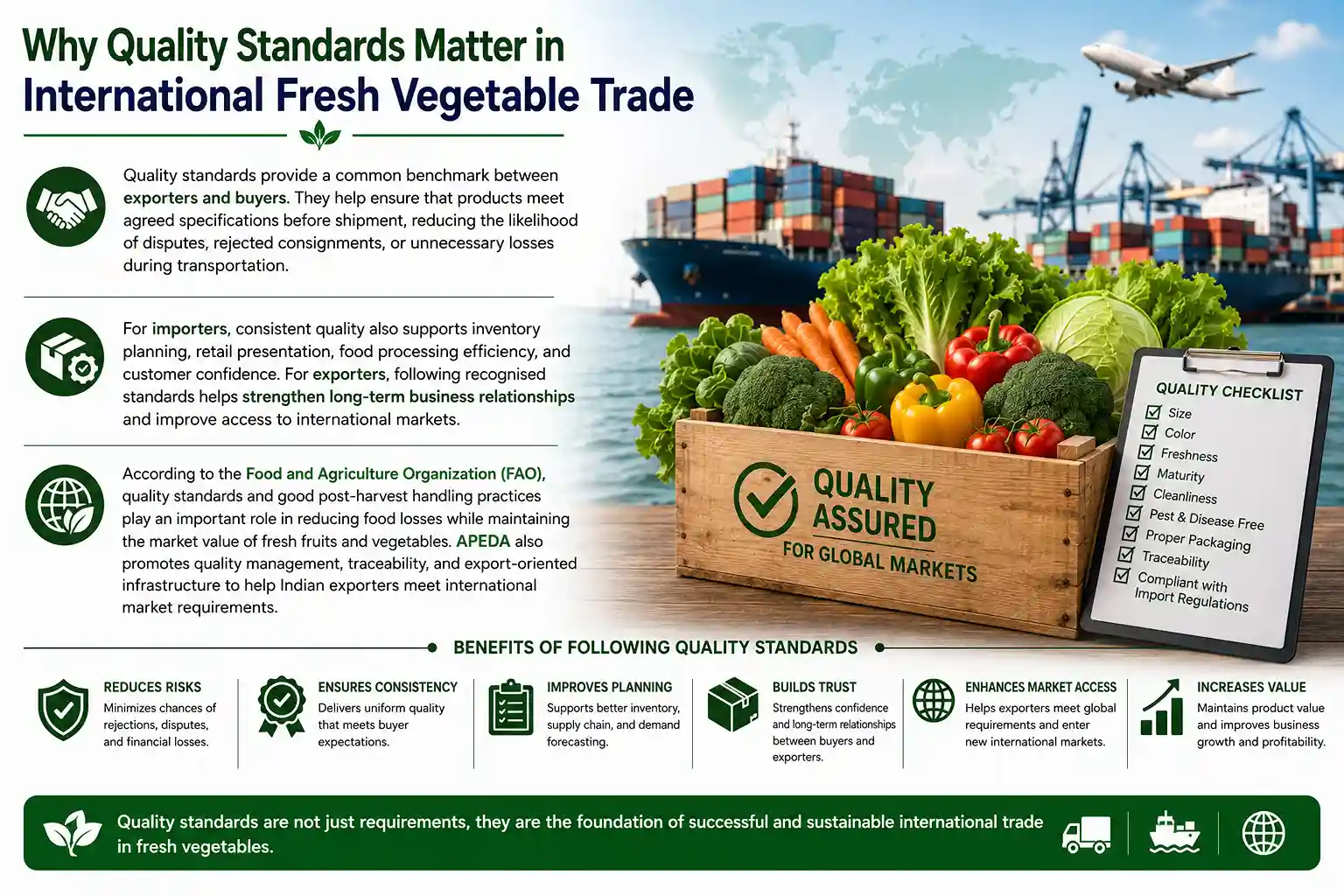
Quality standards provide a common benchmark between exporters and buyers. They help ensure that products meet agreed specifications before shipment, reducing the likelihood of disputes, rejected consignments, or unnecessary losses during transportation
For importers, consistent quality also supports inventory planning, retail presentation, food processing efficiency, and customer confidence. For exporters, following recognised standards helps strengthen long-term business relationships and improve access to international markets.
According to the Food and Agriculture Organization (FAO), quality standards and good post-harvest handling practices play an important role in reducing food losses while maintaining the market value of fresh fruits and vegetables. APEDA also promotes quality management, traceability, and export-oriented infrastructure to help Indian exporters meet international market requirements.
What International Buyers Expect from Export-Quality Vegetables
Buyers rarely evaluate vegetables based on appearance alone. They typically assess whether products can consistently meet agreed quality specifications across every shipment. Common evaluation criteria include:
- Uniform size and grading
- Fresh appearance and colours
- Freedom from visible defects or contamination
- Suitable packaging for international transportation
- Compliance with buyer specifications and destination-country requirements
While these expectations may vary between markets, the objective remains the same—receiving products that maintain their quality from origin to final delivery. Before comparing individual products, it's helpful to understand how India's export industry supports international buyers. Our complete guide to fresh vegetable exports from India explains the export ecosystem, supply chain, and sourcing advantages in greater detail.
How Quality Standards Reduce Import Risks
International trade involves long transit times, multiple handling stages, and varying regulatory requirements. Without consistent quality standards, buyers face a greater risk of shipment delays, product deterioration, customs issues, and customer complaints.
Quality assurance begins well before products leave the farm. Proper harvesting, grading, inspection, and handling all contribute to maintaining product quality throughout the export journey. These processes also help exporters demonstrate that shipments have been prepared according to recognised industry practices.
For businesses importing vegetables regularly, choosing suppliers with established quality systems can reduce operational risks while improving supply chain reliability.
Quality Assurance Throughout the Export Supply Chain
Maintaining export quality is a continuous process rather than a single inspection before shipment. Every stage—from sourcing and grading to packaging, storage, transportation, and documentation—contributes to the condition of the product when it reaches the buyer.
In India, APEDA supports export quality through initiatives such as registered pack houses and HortiNet, a traceability system that helps document key stages of the export process for eligible consignments. These systems improve transparency and strengthen confidence between exporters and international buyers.
If you'd like to understand how exporters assess grading, appearance, and product consistency before shipment, continue to the next section on key quality standards for fresh vegetable exports.
Key Quality Standards for Fresh Vegetable Exports
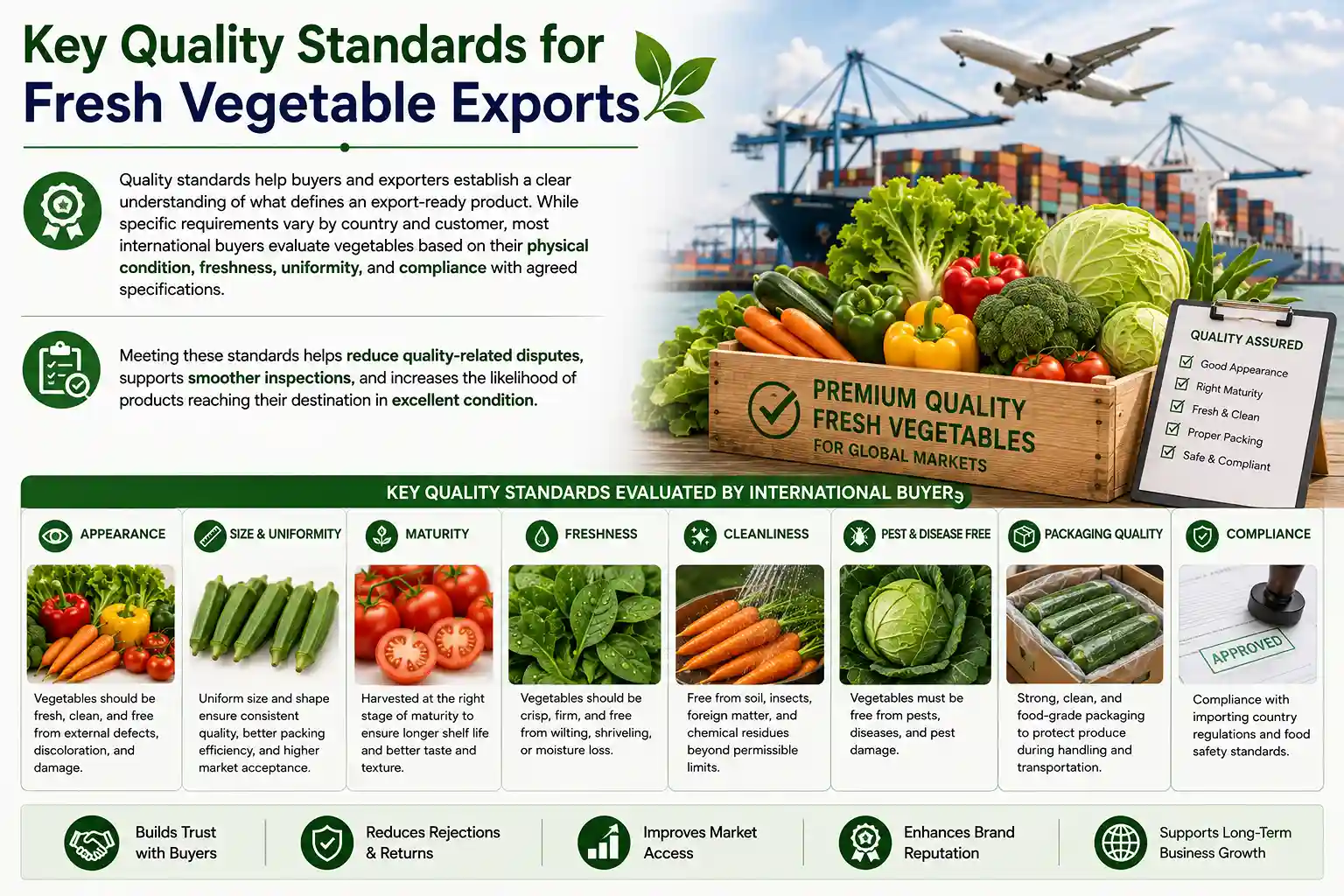
Quality standards help buyers and exporters establish a clear understanding of what defines an export-ready product. While specific requirements vary by country and customer, most international buyers evaluate vegetables based on their physical condition, freshness, uniformity, and compliance with agreed specifications.
Meeting these standards helps reduce quality-related disputes, supports smoother inspections, and increases the likelihood of products reaching their destination in excellent condition.
Physical Quality Parameters for Export Vegetables
The first quality assessment begins with the physical condition of the vegetables. Buyers expect products that are clean, well-developed, and free from defects that could affect marketability or shelf life.
Common quality parameters include:
- Uniform size and shape
- Natural colour for the variety
- Fresh appearance
- Freedom from cuts, bruises, decay, and pest damage
- Proper maturity for export
- Clean surface with minimal foreign matter
Although exact specifications differ between buyers, consistency across the entire shipment is often just as important as the quality of individual vegetables.
If you're comparing products for your market, explore our export-quality Onion for international bulk supply, premium Garlic for wholesale export markets,, and fresh Ginger sourced for global importers to see how different vegetables are prepared for international buyers.
Freshness, Maturity & Shelf-Life Requirements
Freshness directly influences how well vegetables perform throughout international transportation. Products harvested too early may not develop the desired characteristics, while over-mature vegetables can lose quality before reaching their destination.
Exporters carefully consider factors such as:
- Harvest maturity
- Firmness
- Moisture retention
- Natural shelf life
- Expected transit duration
Balancing these factors helps buyers receive vegetables that remain suitable for retail shelves, food processing, or wholesale distribution after arrival.
Maintaining freshness doesn't depend on harvesting alone. Packaging methods, storage conditions, and temperature management also play a significant role in protecting product quality during transit. To understand these practices in more detail, read our complete guide to packaging standards for fresh vegetable exports and complete guide to cold chain logistics for fresh vegetable exports.
Product Grading & Uniformity Standards
Product grading helps ensure that every carton or shipment meets the specifications agreed between the buyer and exporter. Rather than focusing on individual vegetables, grading evaluates the consistency of the entire consignment.
International buyers often expect uniformity in
- Size and weight
- Colour and appearance
- Ripeness or maturity
- Quality classification
- Packaging presentation
Consistent grading simplifies handling for importers, improves retail presentation, and supports more efficient inventory management. It also reduces the likelihood of shipment rejections caused by excessive variation within a single lot.
Many international markets also use recognised marketing standards when assessing fresh produce. For example, the UNECE marketing standards for fresh fruit and vegetables provide internationally recognised quality requirements for a wide range of products, while the European Union marketing standards for fruit and vegetables establish quality and labelling requirements for produce entering EU markets. Understanding these expectations helps exporters prepare shipments that align with destination-country requirements.
If your business imports vegetables into regulated markets, our step-by-step guide to export documentation and compliance for fresh vegetables explains how quality documentation supports international trade.
International Food Safety Standards & Certifications
Meeting international quality expectations goes beyond product appearance. Importers also want confidence that fresh vegetables have been produced, handled, and prepared using recognised food safety practices.
Depending on the destination market, buyers may request specific certifications or require suppliers to demonstrate compliance with internationally accepted agricultural and food safety standards.
GlobalG.A.P. and Good Agricultural Practices (GAP)
One of the most recognised standards in the fresh produce industry is GlobalG.A.P. It provides a framework for Good Agricultural Practices (GAP), helping farms demonstrate responsible production methods, food safety, worker welfare, environmental management, and product traceability.
While GlobalG.A.P. certification is not mandatory for every export market, many supermarkets, retailers, and international food distributors prefer sourcing from suppliers operating within recognised agricultural standards.
For buyers, this provides greater confidence that products have been grown and handled using internationally accepted farming practices rather than relying solely on visual inspection.
If you're sourcing vegetables for retail or organised food distribution, asking suppliers about their farming practices and quality systems is an important part of the supplier evaluation process.
FSSAI, APEDA & Export Compliance in India
Indian exporters operate within a regulatory framework designed to support food safety and international trade. Depending on the business and destination market, exporters commonly maintain registrations such as:
- GST Registration
- Import Export Code (IEC)
- FSSAI Registration
In addition to these registrations, APEDA plays an important role in promoting agricultural exports by supporting quality improvement, export infrastructure, traceability initiatives, and market development for Indian produce.
These registrations and industry frameworks help exporters participate in international trade while demonstrating their commitment to recognised business and food safety practices.
If you're unfamiliar with the documentation required before an international shipment leaves India, our step-by-step guide to export documentation and compliance for fresh vegetables explains the process in greater detail.
Understanding International Food Safety Requirements
Every country establishes its own import regulations to protect consumers and prevent the introduction of pests, diseases, and unsafe food products. As a result, exporters must ensure their products comply with the requirements of the destination market before shipment.
International buyers commonly evaluate suppliers based on factors such as:
- Food safety practices
- Product traceability
- Residue compliance where applicable
- Packaging and labelling requirements
- Supporting export documentation
For exports to the European Union, fresh fruit and vegetables must also comply with applicable marketing standards and official controls relating to food safety and plant health. Similar requirements exist in many other international markets, although the exact regulations differ from country to country.
Meeting these requirements is not simply about regulatory compliance—it also helps buyers reduce import risks, improve customs clearance, and maintain confidence in their supply chain.
To learn how exporters prepare vegetables before shipment and minimise quality risks during transportation, explore our complete guide to maintaining export quality through packaging and cold chain logistics.
Phytosanitary Requirements for International Markets
Phytosanitary requirements help protect agriculture by preventing the spread of harmful pests, diseases, and plant contaminants through international trade. Before fresh vegetables enter many countries, importing authorities may require evidence that the shipment complies with their plant health regulations.
While the exact requirements differ between markets, understanding phytosanitary compliance helps both exporters and importers avoid shipment delays, inspections, or rejected consignments.
Why Phytosanitary Certification Is Important
A phytosanitary certificate is an official document issued by the National Plant Protection Organization (NPPO) of the exporting country. It confirms that a shipment has been inspected and meets the plant health requirements of the importing country, based on internationally recognised phytosanitary measures.
For international buyers, this certificate provides confidence that the products have undergone the necessary plant health inspections before export. It also supports smoother customs clearance by demonstrating compliance with destination-country regulations.
Beyond regulatory compliance, phytosanitary certification helps minimise the risk of introducing invasive pests and plant diseases into agricultural production systems around the world.
If you're importing fresh vegetables from India for the first time, understanding the required certificates before placing an order can help prevent unnecessary shipment delays. Our step-by-step guide to export documentation for fresh vegetable shipments explains the documents commonly required for international exports.
Export Requirements for the European Union and Other Global Markets
Every importing country establishes its own rules for fresh vegetable imports. These regulations may cover plant health, pesticide residue limits, packaging, labelling, traceability, and product quality
The cold chain may include refrigerated storage, reefer containers, and continuous temperature monitoring depending on the product and destination market.
For example, European Union member states require imported fresh produce to comply with plant health legislation designed to prevent the introduction of quarantine pests. Similar import controls are also applied by many countries in the Middle East, North America, Asia-Pacific, and other international markets, although the specific requirements vary.
Because regulations are regularly updated, exporters and buyers should always verify the latest import conditions for their destination country before shipment. Working with an experienced export partner can help ensure documentation and compliance requirements are addressed during the export planning stage.
Preventing Pest & Disease Risks During Export
Maintaining plant health begins long before a shipment reaches the port. Exporters work with growers, pack houses, inspection authorities, and logistics partners to reduce contamination risks throughout the supply chain.
Common practices include:
- Field monitoring before harvesting.
- Careful sorting and grading.
- Cleaning and hygienic handling.
- Inspection before export.
- Secure packaging to minimise contamination during transit.
Combined with traceability and quality management systems, these measures help exporters prepare vegetables that meet international buyer expectations while supporting compliance with importing country regulations.
Maintaining plant health is only one part of successful international trade. Proper handling after inspection is equally important. To understand how exporters preserve product quality during transportation, read our complete guide to packaging standards for fresh vegetable exports and complete guide to cold chain logistics for fresh vegetable exports.
Inspection, Testing & Export Verification
Quality standards become meaningful only when they are verified before shipment. That's why international buyers often request inspection reports, laboratory testing, or supporting documents to confirm that fresh vegetables meet the agreed specifications.
A structured inspection process helps identify potential issues before products leave the country, reducing the risk of rejected shipments, disputes, or unexpected delays after arrival.
Quality Inspection Before Shipment
Pre-shipment inspections help verify that vegetables match the quality standards agreed between the exporter and the buyer. Depending on the product and destination market,inspections may assess appearance, grading, packaging, labelling, and overall shipment condition.
During the inspection process, exporters typically check:
- Product size and uniformity
- Colour and visual appearance
- Freshness and maturity
- Packaging condition
- Quantity and labelling
- Overall shipment quality
Completing these checks before dispatch allows any issues to be addressed early, helping buyers receive products that match their procurement requirements.
If you're comparing export-ready products after understanding the inspection process, explore our export-quality Onion for international bulk supply, premium Garlic for wholesale export markets, or fresh Ginger sourced for global importers to learn more about the quality specifications available for international buyers.
Choosing a Reliable Third-Party Inspection Service
Some international buyers prefer independent verification before goods are shipped. In these cases, third-party inspection agencies provide an impartial assessment of the shipment based on the agreed quality requirements.
When selecting an inspection partner, buyers commonly look for:
- Experience with fresh agricultural exports
- International recognition or accreditation
- Transparent inspection procedures
- Clear reporting and documentation
- Timely inspection before shipment
Independent inspections can improve transparency between buyers and exporters, particularly for large-volume or long-term supply agreements.
Before arranging third-party inspections, buyers should also confirm which documents will accompany the shipment. Our step-by-step guide to export documentation for fresh vegetable shipments explains the paperwork commonly prepared before international dispatch.
Laboratory Testing & Product Traceability
Some export markets require laboratory testing to verify that products comply with applicable food safety or residue requirements. The exact testing requirements depend on the destination country, product category, and buyer specifications.
In addition to laboratory testing, traceability systems help record important information throughout the export process. According to APEDA, HortiNet supports traceability by documenting registered farms, approved pack houses, lot identification, and other stages involved in eligible fresh produce exports.
For international buyers, traceability provides greater visibility into the product's journey and supports confidence in the overall supply chain.
Laboratory testing is only one part of maintaining export quality. Proper packaging and temperature-controlled transportation also help preserve the condition of vegetables after they have passed inspection. Learn more in our complete guide to packaging standards for fresh vegetable exports and complete guide to cold chain logistics for fresh vegetable exports.
Packaging Standards That Help Maintain Export Quality
Even the highest-quality vegetables can lose value if they are not packaged correctly. Export packaging protects fresh produce during handling, transportation, and storage while helping maintain its quality until it reaches the buyer.
The right packaging also improves ventilation, reduces physical damage, and makes loading and unloading more efficient throughout the international supply chain.
Selecting Suitable Export Packaging Materials
There is no single packaging solution for every vegetable. Exporters select packaging materials based on the product, shipping method, destination market, and buyer requirements.
Common packaging options include:
- Corrugated cartons
- Mesh bags
- Plastic crates
- Food-grade liners
- Ventilated cartons
The objective is to protect the vegetables while allowing adequate airflow and making the shipment easier to handle during transportation.
Packaging requirements often vary between products. If you're comparing vegetables for your next shipment, explore our export-quality Onion for international bulk supply, fresh Chilli for international food supply, or export-ready Lemons for wholesale buyers to understand the packaging options available for different products.
Packaging for Longer Shelf Life
Fresh vegetables continue to respire after harvesting, making packaging an important factor in preserving freshness. Proper ventilation, moisture control, and careful stacking help slow quality deterioration during storage and international transit.
Exporters also consider factors such as:
- Transit duration
- Destination climate
- Product sensitivity
- Storage conditions
- Mode of transport
Selecting suitable packaging based on these factors helps reduce spoilage and maintain product quality throughout the journey.
Packaging works best when combined with temperature-controlled logistics. To understand how exporters preserve freshness from dispatch to delivery, read our complete guide to cold chain logistics for fresh vegetable exports.
Protecting Product Quality During Transportation
International shipments often pass through multiple stages, including loading, port handling, customs clearance, shipping, and local distribution. Packaging must protect the vegetables throughout each of these stages without compromising product quality.
Well-designed export packaging helps:
- Minimise bruising and mechanical damage.
- Improve airflow around the produce.
- Support stable stacking inside containers.
- Reduce handling-related losses.
- Deliver products in better condition.
Proper packaging is only one part of the export process. Documentation, inspections, and logistics planning also contribute to successful international deliveries. If you'd like to understand how these elements work together, explore our step-by-step guide to export documentation for fresh vegetable shipments.
Ready to source fresh vegetables from India?
Get in touch with our export team for pricing, specifications, and bulk availability.
Contact Our Export Team